Howdy,
I can't believe how long it's been since I last posted. Lot's of things have changed since then. I graduated from Seneca College for Creative Advertising, got an internship at an ad agency, and now, well, now I'm back at for video game design and development and loving it.
Why this crazy 180 career change you ask?
Well, I felt like I wasn't going anywhere in the ad industry and I guess it just wasn't for me. I decided to switch career paths back in November of last year. It's already been almost a year? Wow, time flies.
Why did I choose the video game industry? I love video games and I stumbled on some schools who teach this stuff. The rest is history.
I'm really excited to be studying at RCC Institute of Technology in Concord, Ontario, Canada. My class is making a game (third person brawler, with a Diablo style camera) and I just so happen to be the lead programmer on it. Right now, I've been working on the AI for the game.
I going to try to blog regularly from now on(I know I said that previously, but this time I mean it). Only now, I'll be blogging about the video game industry mostly(I'll throw in some advertising stuff too).
Okay, so I'm done for now.
Peace out and thanks for reading.
Showing posts with label Advertising. Show all posts
Showing posts with label Advertising. Show all posts
Saturday, September 27, 2014

Saturday, April 7, 2012
Book Review: Guerrilla Marketing (4th Edition)

Author: Jay Conrad Levinson
So after all this time, finally I'm doing another book review. I decided to read this book because one of my teachers recommended it. It took me quite a while to read; it's a long book with teeny tiny type in it. But that won't factor into the review. I will be reviewing on context, not on how long it took me to read the book- which was a while.
If you are into advertising and you want a job in advertising, or already have a career in advertising, this book is probably not for you (unless you are on the account side). This is more of a marketing book. That's why it says marketing in the title. But, if you have a small business, this book is definitely for you. It has all the tools you need to get your small business marketing plan off the ground.
One thing I didn't like about this book was the lack of real life examples. The author does use some, but he doesn't give any names of companies or people. I know he does this for anonymity, but I felt that I could not connect to anything in the book; it all seemed distant. I wish there were more real life examples. Th best ones that Levinson did put in were about his own experiences. Those felt more real to me than any of the other examples he put in, probably because he mixed in some fake examples with some real life ones.
I know I said that I wasn't going to talk about this, but some of the chapters were ridiculously long. They went on forever. I know the author was trying to be thorough, and he did a really good job of covering all his bases, but really, some chapters were 60-odd pages long. When a book has really long chapters, it feels like it takes even longer to read.
I felt that since I'm an advertising student, many of the chapters did not apply to me. Although the E-Media Marketing and Human Media Marketing chapters were particularly enlightening to me. In fact, the E-Media Marketing chapter actually helped me with this blog!
Some of the content was definitely good and worth the read. However, if you're planning on going creative in the advertising business, I'm really not sure that this book is for you. As I said before, it is more of a marketing book. Although there are some good tips about marketing yourself in this book, there are other, more advertising specific books that would probably help you more. But, if you have a small business, you should read this book because it doesn't tell you to go and buy expensive advertising; it tells you to create a long term plan for your business.
I'm not sure what else to say on that topic. I made my recommendations and I'm going to stick with them. It was worth reading, even if I don't feel that would help me. Hopefully, this book is right for you.
That's all for now.
Monday, December 26, 2011
Book Review: Truth, Lies & Advertising

Author: Jon Steel
What is an account planner? What kind of job is it? What does it take to be a good account planner? Jon Steel raises these questions in his book, and answers all of them. First, he says what not to do, then he gives advice on what you should do based on examples from his personal experience.
I like the fact that Steel admits that these are only suggestions in his book, not laws that you have to follow. That's because each situation is different, especially when dealing with people and brands.
The stories that he uses are extremely entertaining, and paint a perfect picture in your mind about what an account planner has to go through. These stories provided a good flow to the book, and made it quite easy and fun to read.
Each chapter in the book presents a different problem that an account planner must face pretty much in the order that it happens. It makes the book feel like a whole campaign, from beginning to end, even though there are lot's of stories in it from many different campaigns that the author worked on.
This book may have "Account Planning" in the sub-title, but it is definitely not just for people who want to be account planners. Creatives should read it too because it provides really good advice, and because it describes how hard it is to get a campaign off the ground.
I would recommend this book to anyone who is interested in advertising because it is fun to read and provides valuable insight into agency life.
Now, you may be thinking, "This book was published in 1998. It's out of date!" It may be older, but it's still extremely useful. Things change in the business all the time. But, human interactions remain the same, whether it is face to face, like focus groups, or really weird methods of research.
Read this book. It will help you get a better perspective on account planning. But don't just read it for that, read it because it is a really good and fun book to read.
That's all for now!
Sunday, December 18, 2011
Book Review: Hey Whipple, Squeeze This.

Author: Luke Sullivan
I read this book a while ago, and I finally got around to reviewing it (I was very busy at school). I'm glad I finally decided to review it, because there is a new edition coming out in the year.
Let me just say this: Wow.
I had to buy this book because it was recommended reading for school. I bought last January, just as I was beginning to study advertising. It sat on my shelf for a few months because I just didn't really care to read advertising books at the time, unless a teacher assigned a reading.
When I finally did decide to read it, I couldn't put it down, which, looking back, is probably a bad thing because I probably should have taken notes, but whatever.
I hear that this is the best book that was written about about advertising of all time (my teachers have said that). As of right now, I have to agree (although there is another book that I'm chomping at the bit to review which is a close second). Sullivan describes everything, from what it's like to be an advertising creative, to how to sit down and write ads. Probably my favourite chapter is the one in which he describes some horror stories about clients. It was probably the funniest part of the whole book.
Sullivan uses excellent examples of great ads throughout his book to hammer his points home, and he has no shame in showing off the first ad he ever did. I've got to say, he's come a long way. He became one of the best copywriters in the business.
Whipple was a lot of fun to read. I especially love the short paragraphs and the sub-heads: those really break up the book and let it flow better. I can't stand books with really long chapters and no sub-heads; you never feel like you get anywhere when you are reading them. But, I digress.
If you want to learn a lot about advertising in one read, then read this book. It is a must for anyone who is either in the business, or someone who aspires to be. Even account people should read it. It's that important.
I'm looking forward to the new edition because there will be lots of great information all about new media and digital packed into it. That was the only thing that was lacking in this edition. But you can't blame the author, they weren't as big at the time.
This book is a lot of fun, and it sure makes the ad business sound like fun too.
That's all for now.
Sunday, December 11, 2011
The Ad Bits Holiday Gift Guide

Saturday, November 19, 2011
A Night at the ADCC Awards

I also thought I would try out an app that I downloaded recently from the Android Marketplace which is some cool retro camera app. That's why the picture looks so interesting.
I wasn't allowed to take any pictures during the show, but I thought I would post some of the swag that you got if you were able to attend. Notice the really well designed book and posters with a common theme. Pretty awesome. The contents of the annual are really good too, of course.
So, on to the awards. It was an interesting ceremony to to say the least. Some really great stuff was honoured, some it design, and some of it advertising. Wow, I'm good at stating the obvious sometimes.
The speeches had to be the best part. They were the shortest speeches that I've ever heard. I guess I'm just used to the ones that you hear during things like the Academy Awards. The designers didn't say anything, and the ad people pretty much just thanked the client. The speech of the night went to a writer who had to accept an award on behalf of the agency for best cinematography in an ad. This is what she said:
"I'm accepting this award on behalf of the agency, because clearly, as a writer, I had a lot to do with the cinematography of this commercial."
I kid you not. It was pure awesome, and completely hilarious.
It was a pretty short awards show. Quite a few awards were given out, but I think the whole show lasted around an hour. The big winners were Rethink and Leo Burnett Toronto. They cleaned up. Leo Burnett Toronto also won agency of the year.
Overall, it was a fun night, with a lot of great Canadian work in the advertising and design fields being honoured. I would like to congratulate all of the winners, even though it's a little late.
That's all for now!
Sunday, November 13, 2011
Book Review: The Do-It-Yourself Lobotomy

Author: Tom Monahan
Read this book. Seriously. If you are serious about going into creative advertising, or any job that involves some sort of problem solving, then you need to read this book.
This is essentially a brainstorming book, with all kinds of different ways you can brainstorm, either individually, or in a group. The names of some of the techniques are wacky, and will entice you to the point that you don't read the book in order.
You shouldn't read this book in order anyway. Read any section that you want at any time. It makes it much more fun. You will find yourself referring back to this book quite often, especially when you realize that these brainstorming techniques actually work.
Besides all of the brainstorming techniques, Monahan also introduces you to the idea of talent vs. creativity. I won't spoil it for you, but I know a lot of people will breathe a sigh of relief when they read that section.
Also intertwined throughout the book are little quotes from famous creative people and testimonials from people who took Monahan's course in brainstorming. This makes for great breaks in the action, and throws you some curve balls that make you think. Sometimes, no matter how great a book can be, you can almost get lulled to sleep by the act of reading (at least, that happens to me sometimes). But with all these little breaks that Monahan puts in, that will not happen and your eyes will end up moving all over the page.
My favourite feature that this book has are what Monahan calls Cheat Notes. They summarize the chapter that you just read, so if you forget something and don't want to read the whole chapter again, you can just read the Cheat notes instead of skim.
I found myself using some of the techniques that Monahan described in my own work, wither in a group, or individually. They were very helpful and made for some good fun. A few pretty good ideas came of those sessions too.
I highly recommend this book. If you are in any job where you have to problem solve all the time, then this book is for you. This isn't just an advertising book, this is a Do-It-Yourself Lobotomy.
Don't forget to follow me on Twitter for even more insights into what it's like being an advertising student. That's all for now!
Monday, October 31, 2011
I can't get this ad out of my head
Some ads are really catchy just like music to the point that it kind of gets stuck in your head. Well, at least I picked a great ad to get stuck in my head. The writing in it is absolutely brilliant. Check it out below and enjoy.
Tuesday, October 25, 2011
I Hope Long Copy Isn't Dead
You just don't see a lot of long copy ads any more. Most of the ads I've seen recently have been visual puns or ads with only a little bit of copy. I really hope it's not the end of long copy. I guess advertisers think that people have short attention spans and they don't like read anything, but wouldn't you figure that if someone is interested in something, they would take the time to read it? Just a thought.
This is a short blog today. More will be coming in the next few days. If anyone has some favourite long copy ads, let me know, I want to see them. In the mean time that's all for now. Don't forget to follow me on Twitter @GalacticGirlx2 for even more insight into what it's like to be a student of advertising.
This is a short blog today. More will be coming in the next few days. If anyone has some favourite long copy ads, let me know, I want to see them. In the mean time that's all for now. Don't forget to follow me on Twitter @GalacticGirlx2 for even more insight into what it's like to be a student of advertising.
Sunday, October 23, 2011
Book Review: Unleashing The Ideavirus

Author: Seth Godin
Unleashing The Ideavirus is not a new book. In fact, its over 10 years old. But, a lot of the information in it is still relevant today because of how important the Internet is to peoples' lives.
The book consists of four sections: Why Ideas Matter, How To Unleash An Ideavirus, The Ideavirus Formula, and Case Studies and Riffs. All of the sections in the book do an excellent job of explaining what an ideavirus actually is (I won't spoil it for you, you will actually have to read the book). There are numerous examples given, which help illustrate Godin's point.
The examples do feel dated, probably because I remember that stuff when I was kid and started to first use the Internet. However, they are still relevant because of how important viral marketing has become in recent years.
Overall, Unleashing The Ideavirus is a great book because it was written at the still somewhat early stages of the Internet. Seth Godin is extremely good at predicting things that will happen in the market, but he did make a couple of mistakes that no one could have foreseen at the time, and upon reading them, did make me chuckle a little bit. The first was the way he talked about Palm and what a small company did to promote its services with the Palm Pilot. We all know what happened to the Palm Pilot, and to Palm. But, at the time, both were huge. The second thing was about the Toyota Prius. Godin comments that when the Prius first came out, that it looked boring, and just like any other car. He didn't think that it would take off both because of the look of the car and because a hybrid electric vehicle was a radical idea at the time. We all know what happened here too. Toyota redesigned the Prius and it became fairly popular.
I would definitely reccomend this book to anyone who is interested in learning about viral marketing.
A couple of other things, not related to the book. I know that I haven't been blogging much recently. I've just been too busy and I've been sick too, and very tired. I never finished blogging about Advertising Week, but don't worry, I've got plenty of stuff just waiting to be blogged about from that great event. That will be coming this week. I just felt that I should post a book review since I hadn't done that in a while. Until next time. Don't forget to follow me on Twitter @GalacticGirlx2 for even more insights into what it's like to be an advertising student.
Tuesday, October 4, 2011
Advertising Week 2011 Day 1
Wow, what an amazing day! I went to 4 Advertising Week events today, and saw a keynote speech given to my class by Rob Reilly, CCO of CP+B. I've posted some pictures, but you will notice that a couple of the events are missing and that's because my hands were shaking so my pictures turned out blurry.
The first event that I attended was a seminar called "Winning the Marketing War". It took place in the Reuters building and included a panel of CMOs from Time Magazine, FedEx, CVS Pharmacy, GE. They talked about a lot of things that were obvious to, at least from all my classes about target audiences at school. The panelists stressed the value tht PR can bring to a company and how important it is to the relationship with the customer. They also discussed how important analytics were, and how it is more efficient to consolidate your insight gathering tools when you are a large company. The most interesting part of the presentation was when the panelists were discussing what type of person they would look to hire for their marketing departments. The attributes that they would consider are:
I had to leave this panel early so that I could get to another one, which was quite a distance away.
The next panel that I attended was called "Bravo's Got Reading Down To A Science". This seminar was all about neuromarketing. Neuromarketing is basically scientists hook you up to a brain scanning machine while you are watching, listening to, or reading advertisements and observe which types of the brain light up.
This was a really interesting seminar. Apparently, the first experiments in neuromarketing were on dead fish a few years ago. Now, many companies are using the technique to help give people a better brand experience. It is best used with integrated media because each media is different and serves a different purpose. I got to ask a question at this panel. I asked if consumers found this method creepy, and what companies were doing to ease their fears of it. The panel thought it was a great question. I got some good responses to it. One panelist said that people are scared at first when they see the equipment, but then they don't even realize that they have the stuff on, and in some cases, they fall asleep with the scanning equipment on. Another panelist said that people shouldn't be freaked out because what they are doing is trying to improve the user experience to make peoples' lives more enjoyable.
This panel was really great. Neuromarketing is the future of advertising and branding research.
The next panel that I attended was called "The Next 9 Years". It was hosted by Nick Law, CCO of R/GA and Barry Wacksman, Chief Growth Officer at R/GA. This seminar was all about how digital shop R/GA has changed its business model every 9 years as technology has changed. They talked a lot about how brands have grown, especially the model that they call Function Integration. Brands that have done this include Apple, Nike, Google, BMW, and Amazon.
For their next 9 years, R/Ga wants to become the World's first functionally integrated agency, meaning that they don't just do one thing and buy up a bunch of stuff. They want to be able to build brand experiences for their clients. They need a lot of different people on their team besides technologists. Nick Law put it perfectly when he said: "How diverse must we get to get good?" He was talking about how they want to provide the best brand experiences in the World, but that it can't be done unless they have a team full of different specialists who can bring something different to the table.
This panel was really interesting. I had to leave early, though, to get to the next seminar, which was quite a distance away.
The next seminar was probably my favourite. It was called "USA Today Presents: Cannes Lions International Festival of Creativity". It was all about Droga5's campaign for Jay-Z's book: Decoded. This panel included David Droga, the founder of Droga5, Julie Grau from Random House Publishing, Eric Hadley, the General Manager of Worldwide Marketing for Microsoft and Bing, and John Meneilly, Jay-Z's manager. They spoke about how the campaign came together, and about how people worldwide got involved. What they did for the campaign was they put every page of Jay-Z's book outside somehow, on a billboard, on plates in a restaurant, in a swimming pool, etc. The places also had to be relevant to what was on the page in the book. Bing integrated a campaign and game for people to try to find where all these advertisements were, after a clue was given out on a social media site. It was an unbelievable and amazing campaign. I can see why it won the Cannes Lion Grand Prix.
I got to ask a question in this panel. I asked everyone what the biggest challenge was for the campaign other than the budget, and if there were any major disagreements between parties because it was such a big undertaking. David Droga said that time was the biggest challenge. They had to crank out the ads pretty fast, and they could have done even more if they had a couple of months for each ad. Julie Grau said that people in her office would say to her: "I'll believe it when I see it," when she would explain what they were going to do for the campaign.
This panel was amazing. I really enjoyed it. It was extremely insightful, and it was an honour to be able to ask a question and have it answered by such giants in so many industries.
I was quickly off to my class's keynote talk by Rob Reilly. This was a really great talk. He answered many questions, from how to get into the business, to my question about writer's block. I can't say enough things about how amazing that was. Rob Reilly was a really nice guy and thanked everyone, and told everyone who asked a question that they asked a great question. It was a really enlightening talk and a lot of fun. I need to thank my professor, Anthony Kalamut, for organizing this event. It was amazing and super cool.
As you can see, this was a really long day, but a really fun one. I have a lot more on tap for tomorrow as well. I will keep you up to date on everything. So far, Advertising Week has been unbelievable. Don't forget to follow me on Twitter @GalacticGirlx2 for even more insights. That's all for now.
The first event that I attended was a seminar called "Winning the Marketing War". It took place in the Reuters building and included a panel of CMOs from Time Magazine, FedEx, CVS Pharmacy, GE. They talked about a lot of things that were obvious to, at least from all my classes about target audiences at school. The panelists stressed the value tht PR can bring to a company and how important it is to the relationship with the customer. They also discussed how important analytics were, and how it is more efficient to consolidate your insight gathering tools when you are a large company. The most interesting part of the presentation was when the panelists were discussing what type of person they would look to hire for their marketing departments. The attributes that they would consider are:
- The person needs to be able to build an infrastrucure
- The person needs to be creative
- The person needs to analyze and be able to change things on the fly
- Curiosity
- Good listening skills
I had to leave this panel early so that I could get to another one, which was quite a distance away.
The next panel that I attended was called "Bravo's Got Reading Down To A Science". This seminar was all about neuromarketing. Neuromarketing is basically scientists hook you up to a brain scanning machine while you are watching, listening to, or reading advertisements and observe which types of the brain light up.
 | |||
| The Panel for "Bravo's Got Reading Down to a Science". |
This was a really interesting seminar. Apparently, the first experiments in neuromarketing were on dead fish a few years ago. Now, many companies are using the technique to help give people a better brand experience. It is best used with integrated media because each media is different and serves a different purpose. I got to ask a question at this panel. I asked if consumers found this method creepy, and what companies were doing to ease their fears of it. The panel thought it was a great question. I got some good responses to it. One panelist said that people are scared at first when they see the equipment, but then they don't even realize that they have the stuff on, and in some cases, they fall asleep with the scanning equipment on. Another panelist said that people shouldn't be freaked out because what they are doing is trying to improve the user experience to make peoples' lives more enjoyable.
This panel was really great. Neuromarketing is the future of advertising and branding research.
The next panel that I attended was called "The Next 9 Years". It was hosted by Nick Law, CCO of R/GA and Barry Wacksman, Chief Growth Officer at R/GA. This seminar was all about how digital shop R/GA has changed its business model every 9 years as technology has changed. They talked a lot about how brands have grown, especially the model that they call Function Integration. Brands that have done this include Apple, Nike, Google, BMW, and Amazon.
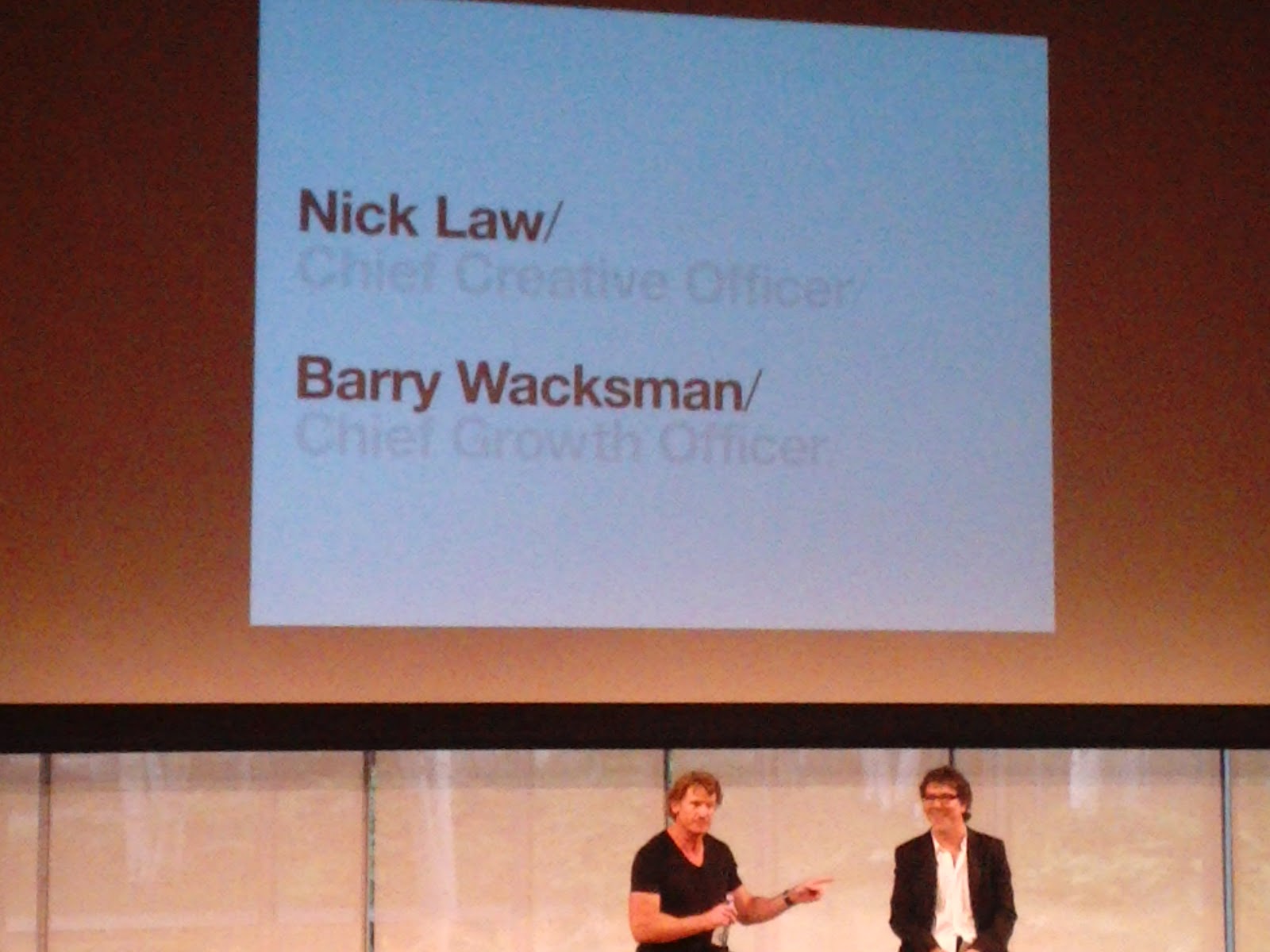 |
| Nick Law and Barry Wacksman talking about "The Next 9 Years". |
For their next 9 years, R/Ga wants to become the World's first functionally integrated agency, meaning that they don't just do one thing and buy up a bunch of stuff. They want to be able to build brand experiences for their clients. They need a lot of different people on their team besides technologists. Nick Law put it perfectly when he said: "How diverse must we get to get good?" He was talking about how they want to provide the best brand experiences in the World, but that it can't be done unless they have a team full of different specialists who can bring something different to the table.
This panel was really interesting. I had to leave early, though, to get to the next seminar, which was quite a distance away.
The next seminar was probably my favourite. It was called "USA Today Presents: Cannes Lions International Festival of Creativity". It was all about Droga5's campaign for Jay-Z's book: Decoded. This panel included David Droga, the founder of Droga5, Julie Grau from Random House Publishing, Eric Hadley, the General Manager of Worldwide Marketing for Microsoft and Bing, and John Meneilly, Jay-Z's manager. They spoke about how the campaign came together, and about how people worldwide got involved. What they did for the campaign was they put every page of Jay-Z's book outside somehow, on a billboard, on plates in a restaurant, in a swimming pool, etc. The places also had to be relevant to what was on the page in the book. Bing integrated a campaign and game for people to try to find where all these advertisements were, after a clue was given out on a social media site. It was an unbelievable and amazing campaign. I can see why it won the Cannes Lion Grand Prix.
 |
| The panel at the Cannes Lions event. |
I got to ask a question in this panel. I asked everyone what the biggest challenge was for the campaign other than the budget, and if there were any major disagreements between parties because it was such a big undertaking. David Droga said that time was the biggest challenge. They had to crank out the ads pretty fast, and they could have done even more if they had a couple of months for each ad. Julie Grau said that people in her office would say to her: "I'll believe it when I see it," when she would explain what they were going to do for the campaign.
This panel was amazing. I really enjoyed it. It was extremely insightful, and it was an honour to be able to ask a question and have it answered by such giants in so many industries.
I was quickly off to my class's keynote talk by Rob Reilly. This was a really great talk. He answered many questions, from how to get into the business, to my question about writer's block. I can't say enough things about how amazing that was. Rob Reilly was a really nice guy and thanked everyone, and told everyone who asked a question that they asked a great question. It was a really enlightening talk and a lot of fun. I need to thank my professor, Anthony Kalamut, for organizing this event. It was amazing and super cool.
As you can see, this was a really long day, but a really fun one. I have a lot more on tap for tomorrow as well. I will keep you up to date on everything. So far, Advertising Week has been unbelievable. Don't forget to follow me on Twitter @GalacticGirlx2 for even more insights. That's all for now.
Saturday, October 1, 2011
Advertising Week in New York
I can't believe it's finally here: Advertising Week! I've waited a long time to go. I first heard about it at orientation last fall, when I didn't have a clue about advertising, and immediately, I wanted to go to New York and take part.
It's going to be a long bus ride down: about 10 hours from Toronto. We will be leaving at around midnight tomorrow, and we will get down there by about 9:00 am-10:00 am Sunday.
Not only am I going to be attending Advertising Week, but I will also be going on some tours of a few of the top agencies in the city thanks to the advertising program coordinator at Seneca, Anthony Kalamut. A big thank you for arranging everything. Not only that, but our whole class is getting a keynote speech by the CCO at CP+B, Rob Reilly.
I will do my best to blog and tweet over the course of the week and hopefully upload some photos and videos of my experience during Advertising Week. I am very excited about this opportunity.
Hopefully the next time I blog, I will be in New York! Until next time.
It's going to be a long bus ride down: about 10 hours from Toronto. We will be leaving at around midnight tomorrow, and we will get down there by about 9:00 am-10:00 am Sunday.
Not only am I going to be attending Advertising Week, but I will also be going on some tours of a few of the top agencies in the city thanks to the advertising program coordinator at Seneca, Anthony Kalamut. A big thank you for arranging everything. Not only that, but our whole class is getting a keynote speech by the CCO at CP+B, Rob Reilly.
I will do my best to blog and tweet over the course of the week and hopefully upload some photos and videos of my experience during Advertising Week. I am very excited about this opportunity.
Hopefully the next time I blog, I will be in New York! Until next time.
Monday, September 26, 2011
Coming Up With Ideas
It can be tough to come up ideas for ads. So much stuff has already been done. They also can't be random ideas- these have to hit the target market exactly.
So why am I writing about this? Well, it's probably because I've had some trouble coming up with ideas lately. I chalk that up to me trying too hard. I want to make great ads, but when you think about to hard, then nothing happens and you end up beating yourself up about it and telling yourself that your not creative.
Probably the best thing to do is just leave your work alone and come back to it later. I found that after being frustrated for hours, I took a break and did something completely different. The ideas still didn't come thought because I was still subconsciously thinking about it. When I started talking to someone, BAM! I suddenly got a few ideas that I could work on. Simple as that.
When you have writer's block, don't think too hard or don't think about what you are working on at all. It worked for me, that's for sure.
A couple other things of note: I now have a YouTube channel, so you can check that out. Just search for GalacticGirlx2 and you can check out a whole bunch of videos that I have favourited. Some of these could make it onto my blog sometime, you never know.
Also, Advertising Week is a week away, and I will be attending! Hopefully, I will have time to blog and give updates about what is going on there. It's going to be a lot of fun.
So that's it for now. Don't forget to follow me on Twitter @GalacticGirlx2 to get even more insights into what it's like being an advertising student, or as my teacher says, a student of advertising.
So why am I writing about this? Well, it's probably because I've had some trouble coming up with ideas lately. I chalk that up to me trying too hard. I want to make great ads, but when you think about to hard, then nothing happens and you end up beating yourself up about it and telling yourself that your not creative.
Probably the best thing to do is just leave your work alone and come back to it later. I found that after being frustrated for hours, I took a break and did something completely different. The ideas still didn't come thought because I was still subconsciously thinking about it. When I started talking to someone, BAM! I suddenly got a few ideas that I could work on. Simple as that.
When you have writer's block, don't think too hard or don't think about what you are working on at all. It worked for me, that's for sure.
A couple other things of note: I now have a YouTube channel, so you can check that out. Just search for GalacticGirlx2 and you can check out a whole bunch of videos that I have favourited. Some of these could make it onto my blog sometime, you never know.
Also, Advertising Week is a week away, and I will be attending! Hopefully, I will have time to blog and give updates about what is going on there. It's going to be a lot of fun.
So that's it for now. Don't forget to follow me on Twitter @GalacticGirlx2 to get even more insights into what it's like being an advertising student, or as my teacher says, a student of advertising.
Tuesday, September 20, 2011
An essay on the digital space
We all know what advertising campaigns used to be like. You would
see an ad in a magazine, on a billboard, or on TV, and then if you so choose,
you would go and buy whatever product or service was being advertised that
caught your attention. All of that is changing. Over the last decade or so, a
new beast had reared its head. Digital and interactive media have changed the
advertising landscape dramatically. Not only can the consumer now follow a
brand on various social media websites, but they can also interact with the
brand, whether it be commenting on a blog post on a brand’s website, or
creating content about that particular brand. Consumers can also get their
content instantly.
PVRs have allowed consumers to skip commercials that they feel are
intruding on their TV time, but now that advertisers post their ads on YouTube
for all to see, many consumers flock there to see the spots. Digital and
interactive advertising have allowed consumers to determine what content they
are exposed to and when.
Digital and interactive have made this an on-demand society. This
can be seen not only in advertising, but in the entertainment industry as well.
Now you can watch television shows on your TV whenever you want, not just
online. Everything is available 24-7 for consumers to enjoy when and where they
want it. This empowerment has given consumers a voice for themselves; they
don’t have to listen to what the advertisers and ad agencies have to say
anymore in the same way.
The consumers’ perception of a brand has changed because of digital
and interactive as well. Digital and interactive have completely changed PR. Brands
can now be assaulted online by consumers if word gets out that they are doing
something that is ethically questionable.
Digital and interactive really has changed the face of advertising.
Advertising is no longer a broadcast, it is a discussion between the brand and
the consumer. The interactions will only get deeper as technology continues to
evolve. We have only scratched the surface in what kinds of advertising can be
done online.
Monday, September 19, 2011
Major Shake Up at Ogilvy Toronto
This is pretty crazy news: The chief co-creative directors at Ogilvy Toronto, Nancy Vonk and Janet Kestin have resigned to launch their own training company, called Swim. They plan to train creatives in agencies, starting with Ogilvy Toronto. Swim launches next month.
Ogilvy named Ian MacKellar as the new chief creative officer of their Toronto office in order to replace the spots that were vacated by Vonk and Kestin. He has really big shoes to fill, but I think that he more than capable of doing a good job. Only time will tell though.
I thought this was an interesting story because it really changes the creative landscape. How will brands like Dove fare in the hands of a different creative chief? This story is definitely worth keeping an eye on in the long term.
The original link can be found here.
Ogilvy named Ian MacKellar as the new chief creative officer of their Toronto office in order to replace the spots that were vacated by Vonk and Kestin. He has really big shoes to fill, but I think that he more than capable of doing a good job. Only time will tell though.
I thought this was an interesting story because it really changes the creative landscape. How will brands like Dove fare in the hands of a different creative chief? This story is definitely worth keeping an eye on in the long term.
The original link can be found here.
Sunday, September 11, 2011
Wheel of Concept

I've wanted to blog about this for a while, but I just didn't have the time. The good folks at Tribal DDB came up with this thing called the Wheel of Concept. You just simply enter a brand name, spin the wheel and it will spit out an idea that you can use for a campaign. It's a lot of fun to play around with.
As an example, I typed in the brand name Rust-Oleum, and according to this application, I should make a campaign that uses augmented reality. I guess if you are stuck on something, you could use it, but I don't think it would be that practical. I used the example I previously mentioned several weeks ago when I first found out about the Wheel of Concept, and it spit out exactly the same idea. Of course according to the website, if you believe that you can come up with better ideas than they have, you should work at Tribal DDB. This does almost sound like a recruiting tool.
Recruiting tool or not, the Wheel of Concept is definitely fun to play around with. You can check it out for yourself here.
That's all for now. Don't forget to follow me on Twitter @GalacticGirlx2 for even more insights into what it's like to be an advertising student.
Friday, September 9, 2011
Book Review: The Idea Writers

Author: Teressa Iezzi
It's been a while since I last did a book review. I was so busy at school that I didn't have time to sit down and write one. But, the time has finally come for another review. I am pleased to share with you my opinion of the Advertising book called "The Idea Writers".
This book is all about copywriting, and more specifically, copywriting in the digital age. The author uses many examples of mostly recent successful campaigns to illustrate her point that a copywriter writes more than just some television commercials and magazine ads. A copywriter is someone who has to come up with ideas that can be used in a fully integrated campaign, especially in the new age of marketing.
In addition to highlighting some of the great campaigns, Iezzi also describes what the copywriter's job entails, as well as what should go into making an ad, including originality, and what life is like in the business.
Iezzi interviewed many copywriters, art directors, and creative directors in order to write this book. The juiciest parts are the various opinions and experiences of the industry professionals. It was great reading about how some of the best campaigns came together right from the people who worked on that particular campaign.
I have two favourite chapters in this book. The first, titled "Life in Adland" was particularly cool because the author asked several copywriters to describe what an average day is like for them for one of the sections in the chapter. Two out of the three wrote down their day as a timeline, including little details like hitting the snooze button a couple of times, and what they ordered for lunch. I thought that was a great touch and it gives you a feel for how hectic life can be like at an agency.
The second chapter that I really liked is called "Bringing Ideas to Life". This is the chapter that goes through some of the best campaigns in the digital age, and a couple of classic campaigns including the famous Economist ad campaign. This was a very enlightening chapter for several reasons. The copywriters, art directs, and creative directors described the process of how they came up with the ideas, most of the time, they were very spontaneous. It also described how much research went on behind the scenes, and how useful that research was in generating the idea.
Overall, I really enjoyed this book. The amount of research that went into writing it was quite apparent. It was extremely informative on the topic of how copywriting has changed since the 1960s, and even has boxes in some of chapters with career tips in them that could be quite useful. There is so much good advice in this book from both the author and the various creatives that were interviewed which could definitely help aspiring copywriters. I recommend this book for anyone who is interested in working on the creative side of the ad business. Not only is this book very informative, but it is also fun to read.
I hope enjoyed this review. That's all until next time. And don't forget to follow me on Twitter @GalacticGirlx2 for even more insights into the life of an advertising student.
Subscribe to:
Posts (Atom)